
The end of an exciting tour through Central Europe, with long rounds of applause in Bregenz
Robert Treviño: “I’m very proud of the orchestra and of this tour. We’ve given high quality performances which show that we’re in a very important place artistically.”
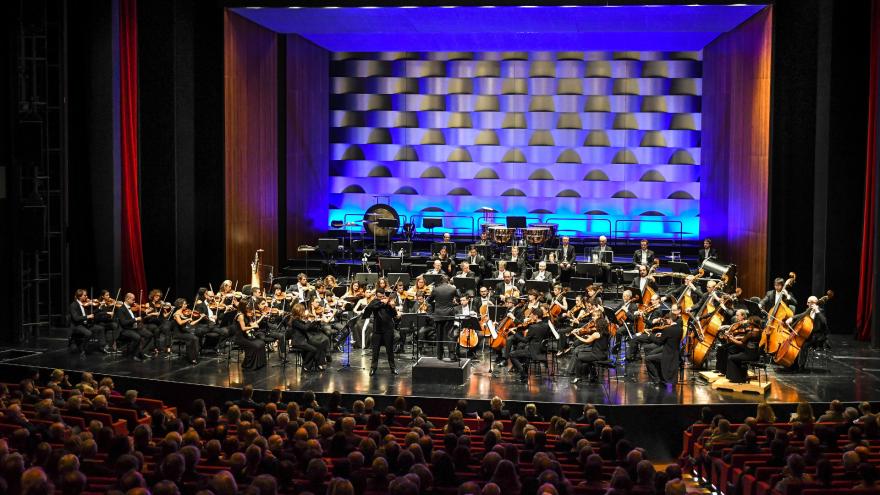
After their appearance in Munich’s Herkulessaal, the Basque National Orchestra returned to Austria for a performance on the shores of Lake Constance, in Bregenz. The orchestra gave its third and final concert of its tour programme on Saturday in the Festspielhaus, a hub of cultural activity with a 1,600-seat concert hall which was barely big enough for the Basque orchestra’s performance. The venue is particularly famous for the summer classical music festival held on the largest floating stage in Europe, with a spectacular seating stand for almost 7,000 people.
In its bid to conquer Bregenz, the orchestra played its trump card in the form of the prestigious violinist Vadim Gluzman, who joined us for the performance of Prokofiev's Violin Concerto No.2. The orchestra's debut in the city featured a strong concert programme (Sorozábal, Prokofiev and Mahler) and two heavyweight soloists: Mojca Erdmann, with us throughout the tour, and the recently mentioned Vadim Gluzman. The entire programme was led by the orchestra's lead conductor, Robert Treviño.
The concert opened once again with a Basque composer, Pablo Sorozábal. The public were taken aback by the selection of three songs from his Siete Lieder sung by the soprano Erdmann, which proved a highly appropriate way of taking to the stage on this tour. Not in vain, Sorozábal wrote this work in Leipzig in the 1920s and was a great lover of German and Central European culture. As we have said over the last few days, the presence of Sorozábal in the programme highlights the Basque National Orchestra's calling to the role of ambassador of Basque culture. It exercised this role once more by introducing the work of German poet Heinrich Heine, translated into Basque and accompanied by Sorozábal's music imbued with Basque rhythms and melodies.
Vadim Gluzman brought in to tackle Prokofiev
The Israeli violinist is world renowned for his performances which are always given under the baton of noteworthy conductors and he has been accompanied by several first-rate orchestras throughout his career. It is therefore important to highlight that Gluzman, not long after starting the Saturday morning rehearsal with our orchestra, told maestro Treviño that he had “a really good orchestra”. Not only that, “it was the best in Spain and among the best in Europe”. Gluzman attacked Prokofiev’s tricky score with a mastery, elegance and virtue that only he can bring to the concerto which premiered in Madrid in 1935. In a recent interview, Gluzman said that for him “the most important aspect of being a musician is the ability to transmit our emotions, thoughts and experiences through sound.” Gluzman reached great heights and touched hearts in the concert hall judging by the audience's response, but he held back and didn’t give an encore.
As with the rest of the tour, the second half of the programme was all about Mahler’s Fourth Symphony. Treviño gave it everything and led the orchestra in a great performance which received long rounds of applause from the public. Then came the now-familiar encores, with R. Strauss performed by Mojca Erdmann and the Intermezzo from La Boda de Luis Alonso by the Sevillian composer G. Giménez. The musicians performed for two and a half hours.
The end of an important tour through Central Europe
Two concerts in Austria (Linz and Bregenz) and one in the emblematic Herkulessaal in Munich, all in venues with a long musical tradition. Throughout, the orchestra has combined Basque music (Aita Donostia and Sorozábal) with a more universal repertoire (Elgar, Prokofiev and Mahler), all of them difficult and risky pieces. Following the tour and all the work involved beforehand, both the Managing Director, Oriol Roch, and the Lead Conductor, Robert Treviño, addressed the full ensemble during morning rehearsal. “Congratulations to the entire orchestra for all of your work. We’re very proud of the orchestra’s standard. We’ve given high quality performances which show that we’re in a very important place artistically.” Oriol Roch announced that he is already working on forthcoming tours.
Basque conquest in Munich’s Herkulessaal
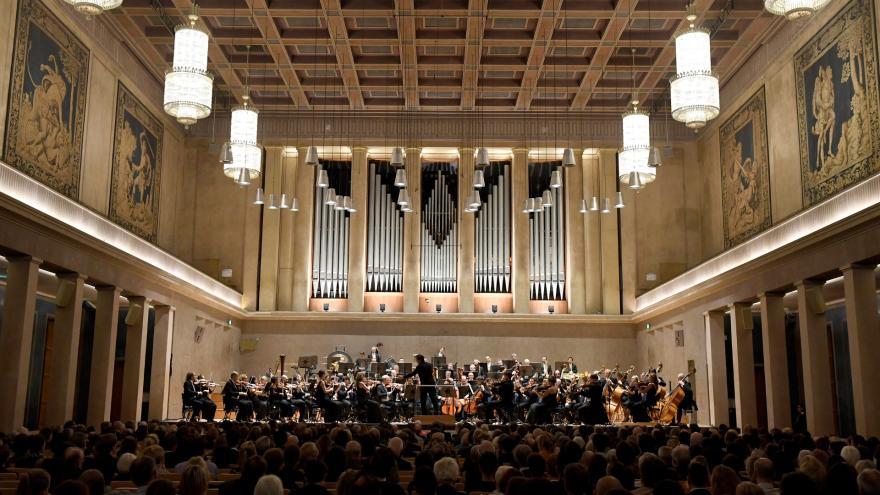
The Basque National Orchestra took to the stage of the prestigious Herkulessaal in Munich with confidence, energy and conviction. The orchestra impressed and triumphed. “I think people couldn’t believe how extraordinary this orchestra is”, said Robert Treviño.
About Munich
A city which is home to three world-class large symphony orchestras, three chamber orchestras and four concert halls with a capacity of almost 6,000 needs no introduction as the powerhouse of Central-European classical music. Having managed to secure a place in the city’s concert programme constitutes a milestone in itself for the Baskisches Nationalorchester. What’s more, the hang-up free programme combining its Basque roots—thanks to Sorozábal—with performances of such great universal composers as Elgar and Mahler sparked the curiosity of the public and the media. Yesterday, in Munich’s Herkulessaal, the Basque National Orchestra gave a stunning performance and reached the highest heights.
Sorozábal...
The Basque National Orchestra is a natural ambassador of Basque culture and on this occasion gave free reign to its roots, opening the concert in Munich with a selection of the Siete lieder written by Sorozábal on German soil, in Leipzig, in 1929. The Basque composer likely never imagined that his music, inspired by the poetry of Heinrich Heine, laden with Basque rhythms and modulations and dedicated to different figures from Basque culture, would be performed in one of the temples of classical music. Listening to the German soprano Mojca Erdmann sing the lieder “Amesetan”, “Lotoren lorak” and “Ez dot sinisten” in Basque was an emotional experience for many of those gathered in the concert hall, and one which confirmed the Basque National Orchestra's role as an instrument for exporting Basque music and culture to the most acclaimed venues. This sentiment was echoed by the Basque Government’s Minister for Culture and Political Policy and President of the orchestra, Bingen Zupiria. Present for the performance, he was “moved by the number of people who attended the concert” and by the fact that the conductor was summoned back to the stage seven times by the rounds of applause. Zupiria added that “if we want to join the world as a country, as well as our industry and economy we have to export culture. The Basque National Orchestra has demonstrated this, and it is a significant example.” Zupiria was also delighted by the high standard of the performance.
...followed by Elgar and Mahler
After opening its performance with Sorozábal, the orchestra began its journey through a universal repertoire much more familiar in these lands. First were Elgar’s Enigma Variations, already performed in Linz and well-rehearsed by the musicians. Yesterday's review of our concert in Linz in the Austrian paper Nachrichten remarked that “In the most famous variation, Nimrod, the orchestra cultivated a fascinating piano culture”, concluding that it was a “coherent concert, with a more than impressive performance of Mahler’s Fourth.”
On that basis, the orchestra’s performance was confident and compelling. Mahler’s Fourth is one of the German composer's most popular symphonies. In fact, the piece has thrice featured in concert programmes in Munich over the past 15 days and will be performed again mid-month by the Munich Philharmonic conducted by Valery Gergiev. On another note, Robert Treviño’s international career is continuing apace. He conducted the Munich Philharmonic in this very concert hall (still ringing with the memory of Mahler's Fifth Symphony) and is becoming a renowned conductor for his performances of Mahler. Robert Treviño has known from the outset that he wanted to take to the stage in Munich with his orchestra, with a big programme, and with Mahler on the music stands, enabling them to show off their strengths and summoning all of their abilities, confidence, conviction and energy. The entire performance was true to his vision. Well-coordinated and in permanent connection with Treviño, the orchestra's rendition of Mahler's Fourth was lauded with a lengthy applause from the public which brought the conductor back to the stage seven times. Mojca Erdmann, now completely recovered after taking ill in Linz, concluded her part with an elegant and refined description of the heavenly pleasures alluded to by the composer in the final movement of the symphony. The orchestra couldn’t leave before giving two encores: the first, Morgen, from the Four Last Songs by R. Strauss, with the soloist Erdmann; and the second, the Intermezzo from La boda de Luis Alonso by Giménez, performed by the orchestra alone.
Maestro Treviño was more than pleased at the end of the concert and wanted to highlight his excitement at everything that took place over the course of the evening. “The audience was incredible, the orchestra was happy, the performance was outstanding, and I think people couldn't believe how extraordinary this orchestra is. I’m very proud of them”, he said.
In addition to the Minister for Culture and President of the orchestra, Bingen Zupiria, also among the audience was the Spanish consul in Munich, Francisco Pascual de la Parte, as well as representatives from the Instituto Cervantes, the Director of the SPRI office in Munich, María Sarricolea, and members of the Basque community resident in the city. All were delighted and taken aback by the quality of the orchestra, including Helmut Pauli, the local programmer in charge of including the orchestra in the Herkulessaal calendar and who is accustomed to the city's intense and celebrated musical life: “The orchestra is comparable to the great ensembles—it has the same level, an extraordinary sound, and has brought out facets of Mahler that we didn’t expect.” “It has been an enormous pleasure to bring them to Munich.”
Our tour continues
This Saturday we return to Austrian territory for a debut appearance in Bregenz. In store is a sold-out concert in the Festspielhaus, a 1,600-seat venue on the shores of Lake Constance. The concert will again feature Sorozábal and Mahler, and we’ll welcome the prestigious violinist Vadim Gluzman for the performance of Prokofiev’s Violin Concerto No.2. This is another very strong programme featuring two experienced soloists and, once again, a mix of Basque and universal music. Saturday, December 8th at 19:30 will mark the last of the three concerts in our tour.
Bira ez da amaitu
Larunbatean berriz itzuliko gara Austriara, oraingoan Bregenzera, Orkestrarentzat lehendabizikoz. Festspielhausen izango dugu entzunareto, Konstantza lakuaren ertzean dagoen 1.600 eserlekuko aretoa, zeinerako sarrera guztiak agortu egin diren dagoeneko. Sorozabal eta Mahlerrekin jarraituko dugu han, eta Vadim Gluzman biolinjole prestigiodunari sarrera emango diogu, Prokofieven 2. Biolinerako kontzertuaren interpretazioarekin. Programa hau ere indartsua izango da, ibilbide luzeko bi solistarekin eta, berriz ere, musika euskalduna eta unibertsala uztartuko ditugu. Larunbatean, abenduak 8, 19:30ean, izango da kontzertua, bira honetarako programatu ditugu hiruetako azkenekoa.
“Brilliant” orchestra on the banks of the Danube
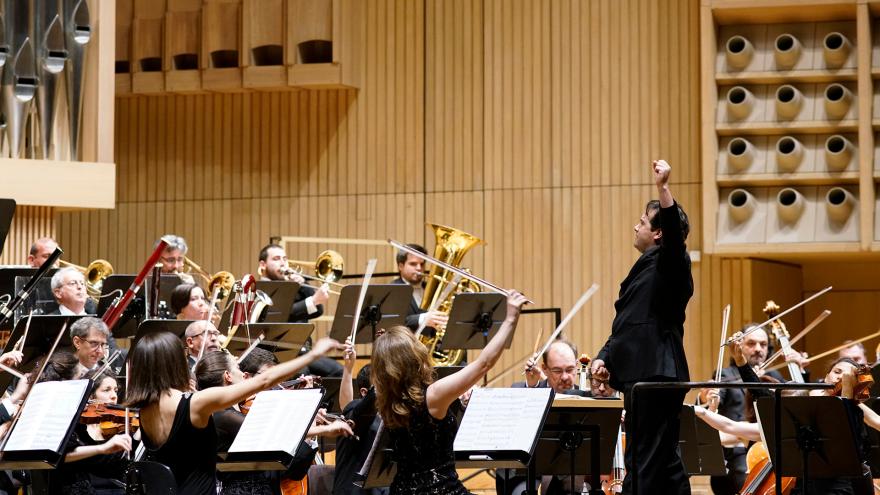
The Basque National Orchestra kicked off its international tour yesterday with an outstanding performance in the Austrian city of Linz.
With the permission of Anton Bruckner—the Linz native to whom the Brucknerhaus concert hall owes its name—our orchestra opened yesterday’s concert in the Upper Austrian capital with Meditación by Aita Donostia. Hearing and performing the work of this Basque composer on the banks of the Danube is immensely exciting for the orchestra. Even more so for someone baptised by him, as Elena Martínez de Murguía, violist in the orchestra, who listened attentively to the work written for organ by her great uncle in 1908 which, subsequently orchestrated, was the first piece played by the orchestra in Linz. This was also the first time that the orchestra performed this short, delicate work which invites the listener to withdraw.
Elgar gate-crashed in Linz
The concert programme suffered a mishap. The soprano Mojca Erdmann—on tour with us, and who gave a solo performance of Mozart in the first part of the programme—took ill at midday and was not fit to tackle the entire programme, instead saving her strength for Mahler’s Fourth Symphony during the second part. Elgar's Enigma Variations had been kept back for the first part of the Munich concert but, making a virtue out of necessity, were summoned early to the music stands in Linz to follow Aita Donostia in the first part of this concert. The orchestra had rehearsed this work well, having performed it all last week as part of their concert season. The musicians therefore adapted confidently to this change and let loose these fourteen variations which evoke the British composer’s friends and helped him achieve fame. The organist Bernhard Prammer, ready to perform Mozart, also swapped his sheet music for the Enigma Variations and gave a voice to the concert hall’s organ. With almost 4000 pipes, it adds great character to the space.
Mahler and more for the second half
The excellent acoustics of the Brucknerhaus in Linz helped the orchestra give a stellar performance of Mahler’s Fourth under the leadership of our lead conductor, Robert Treviño. Mojca Erdmann joined us during the fourth movement of the symphony for the home straight in which Mahler uses the soprano voice to allude to the enjoyment of heavenly life. The public responded, applauded and dubbed the sound of the Basque orchestra—which has been invited to take part in the Internationale Orchester concert series—as “brilliant”. After a two-hour performance, true to form, the orchestra rounded off the evening with a zarzuela encore, performing the Intermezzo from Giménez's La boda de Luis Alonso.
With the concert hall now empty, the dressing rooms of the Brucknerhaus filled with excitement and joy, multiple congratulations between the musicians and the concert organisers, and the immense satisfaction of the lead conductor. This is Robert Treviño’s first international tour as lead conductor of an orchestra—one which “flows through his veins”—and in Linz at least he has been hailed as “brilliant”.
Now it's time to enjoy this Austrian city and start thinking ahead to Munich, where the Herkulessaal concert and a challenging test await on Thursday, December 6th at 8 pm.
More information
Pictures from the concertThe Basque National Orchestra is ready for its next international challenge: Austria and Germany
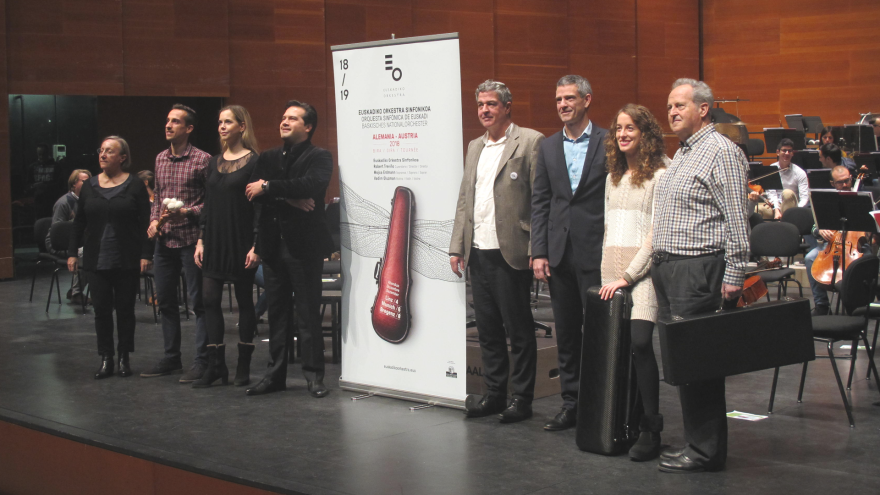
The orchestra's three-concert tour will take in prestigious concert halls in Linz and Bregenz (Austria) and Munich (Germany) between December 4th and 8th.
The final rehearsal before the Basque National Orchestra’s tour of Austria and Germany—with three concerts in Linz, Bregenz and Munich—takes place today, Friday November 30th.
The tour is the most significant international artistic challenge of the season for the orchestra and its first tour with its principal conductor, Robert Treviño.
Treviño and the Baskisches Nationalorchester (as it is being presented) will be joined by the German soprano Mojca Erdmann and the Israeli violinist Vadim Gluzman, the two great soloists invited to join this concert tour.
Programmes and concerts
The orchestra will hit the road on Monday, December 3rd and will give three concerts in noteworthy Central European cities and concert halls with a long musical tradition and demanding audiences: December 4th in the Brucknerhaus, Linz, December 6th in Herkulessaal, Munich, and December 8th in the Festspielhaus, Bregenz.
All three concerts will open with Basque music: Meditación by Aita Donostia in Linz, and Siete Lieder (selection) by Pablo Sorozábal in Munich and Bregenz, with the voice of Erdmann heard for the first time in Basque. Sorozábal, a great admirer of German culture, wrote this work in Leipzig in 1929. His music is infused with Basque rhythms and modulations and each lied is dedicated to one of his friends, each of them personalities from Basque culture. His Siete Lieder are part of the Basque Music Collection recorded by the Basque National Orchestra for the Claves label. The collection has become an undisputed benchmark of Basque symphonic music.
The second part of all three concerts will include Mahler's Fourth Symphony, one of the German composer’s most popular pieces. The German soprano Mojca Erdmann will again take up the solo sections. Each city will set a different tone in the first part of their respective concerts.
After Aita Donostia in Linz, the orchestra and the soprano Erdmann will perform a selection of arias for soprano and church sonatas by Mozart.
Following a selection of Sorozábal's Siete Lieder in Munich, the orchestra’s music stands will carry Elgar’s Enigma Variations in the first part of the programme, in contrast to Mahler’s Fourth Symphony. Under the baton of Robert Treviño, this hugely demanding programme will showcase the strengths of the Basque National Orchestra.
Lastly, in Bregenz, the first part of the programme will feature Prokofiev's Violin Concerto No. 2 with Vadim Gluzman as soloist, in addition to the work by Sorozábal
Before setting off on tour, the orchestra will offer an open general rehearsal tomorrow, December 1st at 11:00 as part of the Miramon Matinees programme. This is a rare and first-class feature in the programme of small-scale chamber concerts usually offered in this cycle. The orchestra will be joined by the soprano Mojca Erdmann for a concert comprising part of the orchestra's tour programme: Mahler’s Fourth Symphony, and a selection of arias for soprano and church sonatas by Mozart. There are no tickets left for the matinee concert.
Treviño and his intense international career
The North American conductor is developing an intense international career. In Europe alone he has conducted, and with immense success, orchestras including the Stuttgart Symphony, the Leipzig Gewandhaus, Rotterdam, the Viena Tonküstler, and the Munich Philharmonic, precisely at the Herkulessaal and where his Fifth Symphony by Mahler is still remembered. Robert Treviño is earning fame as a conductor for his performances of Mahler’s work and his recent versions of the German composer as frontman of the London Symphony Orchestra, the London Philharmonic and the Zurich Tonhalle received public and critical acclaim. Now he wants to return to this legendary hall with Mahler on the music stands and with his Orchestra, which also gives a repeat performance after its first time round in 2003.
International presence of the Orchestra
The Basque National Orchestra is an institution which never fails to fulfil its vocation as ambassador of the Basque culture. That’s why, over its 36 years, it has taken to international stages in different ways and with a variety of objectives.
It has performed in several Festivals and Seasons, such as the Biennale di Venezia and the Opéra Royal Château de Versailles (which it regularly attends with the Malandain Ballet Biarritz, an experience it will repeat in March 2019 with the premiere of “Marie Antoinette”).
Also in the orchestra exchange format, such as its exchanges with the Düsseldorf and Milan’s Giuseppe Verdi orchestras or the classic exchange with the ONBA from Bordeaux.
But its best known format is that of its concert tours, of which this one represents international tour number 18. Since 1984, the Orchestra has toured Argentina, Chile, England and Italy. But above all it has given numerous performances in different Central European cities in Germany (Frankfurt, Stuttgart, Passau, Bayreuth, Augsburg, Hamburg, Bremen, Düsseldorf and Munich), Austria (Vienna, Salzburg and Linz) and Switzerland (Lucerne, Gstaad and Zurich). It will now repeat its performance in Munich (for the third time) and Linz (for the fourth time) and will appear for the first time in Bregenz.
We should highlight, as a new example of relations between the Basque Country, Bavaria and the Austrian region of Vorarlberg, that our visit to Bregenz has been preceded by a collective exhibition “Bilbao – Bregenz” at the Kunsthaus Bregenz, an exhibition commemorating the work of the 40 artists who have participated in exchanges between the Kunsthaus Bregenz and BilbaoArte over the last 10 years (2006-2016).
Tour programme
4th December 2018: Brucknerhaus, Linz (Austria)
AITA DONOSTIA: Meditación
W.A. MOZART: Selection of soprano arias and church sonatas:
- Church sonata no. 14, k.278
- Ergo interest… Quaere superna, Recit and Aria in G major, K.143 (73a)
- Vesperae solennes de confessore, K.339. “Lauate Dominum” in F major,
- Church sonata no. 16, in C major, K.329 (317a)
- Coronation Mass, K.317. “Agnus Dei” in F major
G. MAHLER: Symphony no. 4
Robert Treviño, conductor
Mojca Erdmann, soprano
6th December 2018: Herkulessaal, Munich (Germany)
P. SOROZABAL: Siete Lieder (selection)
E. ELGAR: Enigma Variations, Op.36
G. MAHLER: Symphony no. 4
Robert Treviño, conductor
Mojca Erdmann, soprano
8th December 2018: Festspielhaus, Bregenz (Austria)
P. SOROZABAL: Siete Lieder (selection)
S. PROKOFIEV: Concerto for violin and orchestra no. 2
G. MAHLER: Symphony no. 4
Robert Treviño, conductor
Mojca Erdmann, soprano
Vadim Gluzman, violin
‘A Walk Through Film’ at the Velodrome

The Basque National Orchestra, the SGAE Foundation and the San Sebastian Festival are pleased to present the film music concert that the Basque National Orchestra is offering for the 66th Festival.
This year, once again, the first Saturday of the Festival, the Velodrome will open at noon for music lovers, film buffs and the general public, with a performance blending a symphonic interpretation of soundtracks and a medley of scenes from the films they belong to. An hour and a half of audio-visual delight, Saturday 22 September at twelve noon. Entry is free of cost.
The Basque National Orchestra's film music concert is now a classic at the San Sebastian Festival, one of the must-see shows at the Velodrome, undeniably the most popular stage at the Festival with seating for almost 2,700 spectators. Biscay native composer and orchestra conductor Fernando Velázquez, who promoted the Orchestra's return to the San Sebastian Festival's agenda in 2012 with the world live premier of the soundtrack for The Impossible (J.A. Bayona), will be in charge of conducting the orchestra at this massive convergence of film and soundtracks.
The Concert & Screening this year, entitled "Paseo por el cine (A Walk through Film)," is a collection of music composed for a dozen films. Half of the musical numbers to be performed were composed by Velázquez himself: this includes soundtracks for the films Zip & Zap and the Captain's Island (by Oskar Santos), Gernika (by Koldo Serra) (Marrowbone (by Sergio G. Sánchez), Setback (by Oriol Paulo) —composed with singer-songwriter Zahara— and A Monster Calls (by Juan Antonio Bayona). Indeed, it was the Basque National Orchestra that was commissioned to record the soundtrack for A Monster Calls, whose European premier was at the 2016 San Sebastian Festival. Thanks to its score, Velázquez won the Goya for best original soundtrack. Regarding the upcoming event, in the words of Velázquez (in Spanish):
The repertoire is rounded off with adaptations of the music composed for another five films: Madness for Love (by Juan de Orduña), Tad the Lost Explorer and the Secret of King Midas (by Enrique Gato and David Alonso), The Chosen (by Antonio Chavarrías), All Men are the Same (by Manuel Gómez Pereira) and Go!azen (by Jabier Elortegi and Aitor Aranguren). Juan Quintero, Zacarías M. de la Riva, Arnau Bataller, Bernardo Bonezzi and Álvaro Carmona, respectively, were the composers of these soundtracks.
For this new concert, the Basque National Orchestra invited the Kup Taldea choir, who will participate in “Zip and Zap”, “Gernika,” “Setback," and more. Singer-songwriter Zahara will also be participated in "Setback," and three singers (Iholdi Beristain, Ainhoa Larrañaga and Aritz Mendiola) from the film Go!Azen.
Just like in years past, the concert will have an extra visual element: the music is enhanced by the projection of a montage of scenes from the film on a 400 m2 screen, specifically created for this concert by Carlos Rodríguez, from Morgancrea. What's more, some of the composers will be attending the concert, taking to the Velodrome stage to introduce their work.
Entry is free, and the invitation must be picked up between 15 and 21 September at the San Sebastian Festival information points at Kursaal and Okendo Plaza, from 9:00 to 20:00, or at the Donostia Tourism Office, Monday through Saturday from 9:00 to 20:00, and Sunday from 10:00 to 19:00. The last tickets are available at the Velodrome ticket booth at 10 AM.
Robert Treviño will also be the Chief Conductor of the Malmö Symphony Orchestra
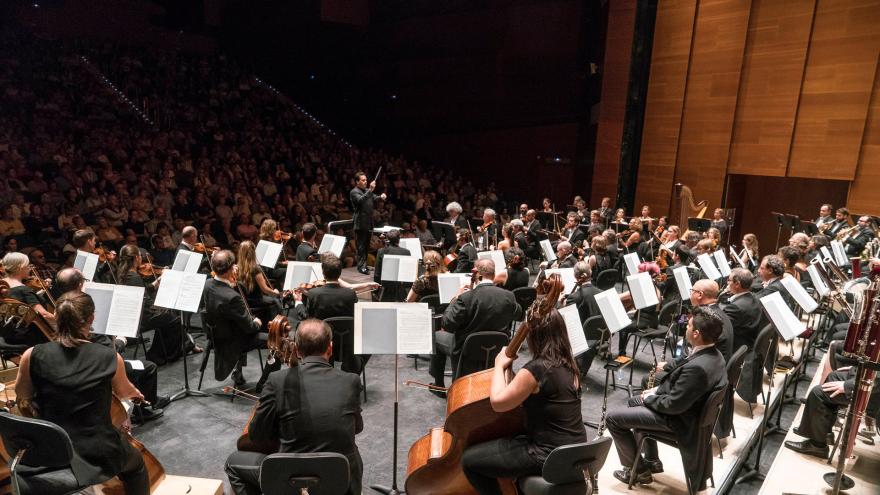
Robert Treviño has been confirmed as the new chief conductor of the Malmö Symphony Orchestra (MSO), taking up the post in autumn 2019. This is going to be the second orchestra in which he holds the main artistic responsibility, having begun his musical career as a chief conductor previously at the Basque National Orchestra.
The Basque National Orchestra has Treviño as chief conductor since 2017/2018 Season. In June an extension of his contract was announced, so his presence as the main artistic responsible in the Basque orchestra is now confirmed until at least the 2021/2022 Season.
Treviño will combine both positions in both orchestras, and will also continue being a regular collaborator with orchestras such as the London Symphony Orchestra, Leipzig Gewandhaus, Vienna Symphony, Sao Paulo Symphony, Munich Philharmonic, Accademia Nazionale di Santa Cecilia, the Zurich Tonhalle Orchestra and many others.
As part of this broad and rich international career of his, he is preparing the tour that will take the Basque National Orchestra to some of the most important and renowned concert halls of central Europe: Brucknerhaus in Linz (4 December), Herkulessaal in Munich (6 December) and Festspielhaus in Bregenz (8 December).
More information
More information at Malmö Symfoniorkester's webpageAll the information about the 2018/2019 Season

The Basque National Orchestra has just finished its 2017/2018 Season successfully, and is already heading towards the next season.
All the information about the 2018/2019 Season is already available: dates, programmes, invited artists and new season tickets. Single tickets will be on sale from 1 August on.
The Basque National Orchestra’s 2018/2019 Season Concerts will begin on 27 September in Pamplona and end on 13 June 2019 in Vitoria. The Orchestra will give 10 concerts at each of its venues in Bilbao, San Sebastián (where it will give double the number), Vitoria and Pamplona, coming to a total of 50.
The coming Season Concerts will continue to enjoy the important presence of its chief conductor, Robert Treviño who will open and close the programme as well as conducting six concert programmes. Treviño’s design envisages continuing to work with the vast symphony sound in a coherent manner, packed with meaning and with a long-term vision.
Hence, for example, the recurring appearance of Mahler as a distinctive note since his early days with the Orchestra. The audience, always attentive to the Mahlerian repertoire, will on this occasion be able to enjoy the composer’s Symphony no. 9, brought to them by the chief conductor, as well as the fine symphony repertoire of authors such as Elgar, Dvorak and Rachmaninoff, whose presence is explained below.
Thus, if, in this current Season (2017/2018) Treviño proposes a look at concepts such as “resistance, conflict and reconciliation” through Shostakovich and Britten, for the 2018/2019 season he concentrates on the concept of “variations”: variations in constant evolution, eternal, unsure and triumphant variations. And to do it he turns the spotlight on three composers: Elgar, Rachmaninoff and Dvorak. Three great composers of difficult connection yet with shared personal experiences and emotions: uncertainty and separation from their roots. Treviño invites the audience to experience, through their art, the feelings with which all people can identify. It is intended as a message of emotion, perseverance and accomplishment.
THE SEASON'S NEW IMAGE
Once again, the image is innovative, modern and fresh, an original visual symphony, a metaphorical composition intended to awaken the attention of spectators, to seduce them and invite them to listen with their eyes. The eleven graphic compositions illustrating the corresponding programmes of the new season are therefore constructed based on two elements represented with different techniques or resources: ancient illustration or engraving and photography. Yesterday and today, music written in a past time and music performed in a present time. From the combination of both elements a new object is born, a visual harmony which illustrates every title, a visual meaning in turn open to interpretation by the spectators themselves.
THE REST OF THE CYCLES
Apart from the Ticket Season, the Basque National Orchestra will continue its activity with the rest of the cycles in 2018/2019:
INTERNATIONAL TOUR
In December, the Basque National Orchestra will set out on a tour of important Central European cities and concert halls of enormous musical tradition and exacting audiences to give three concerts: two in the Austrian cities of Linz and Bregenz, and one in Germany, at Munich’s iconic and coveted Herkulessaal. All three concerts will form part of famous subscribers seasons which enjoy tremendous audience backing.
The Basque National Orchestra sets out on a major international tour with Robert Treviño at the helm
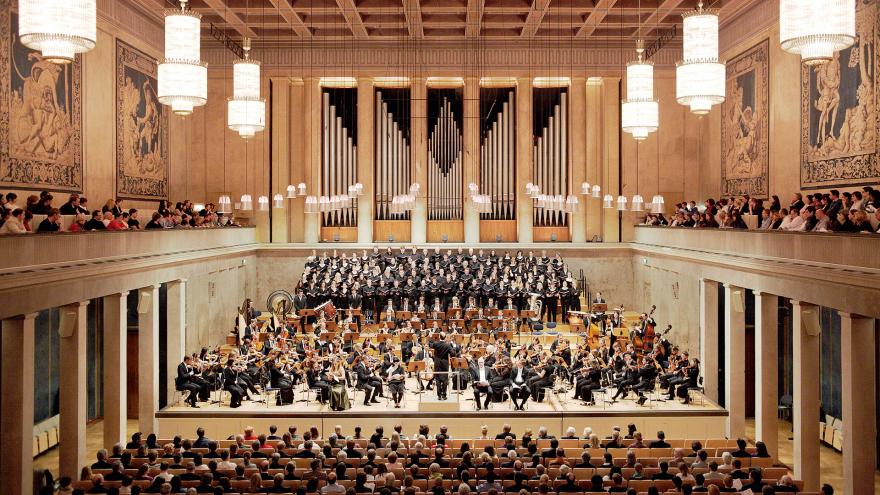
Austria and Germany will be its coming destinations between December 4th-8th.
Robert Treviño, artistic director of the tour, therefore extends his position as chief conductor to a total of five seasons.
Besides its outing to Versailles in March 2019, already announced in the presentation of the 2018/2019 season, the coming months will see a hugely important international artistic challenge. The Basque National Orchestra will set out on a tour of important Central European cities and concert halls of enormous musical tradition and exacting audiences to give three concerts: two in the Austrian cities of Linz and Bregenz, and one in Germany, at Munich’s iconic and coveted Herkulessaal. All three concerts will form part of famous subscribers seasons which enjoy tremendous audience backing.
This tour will be conducted by Robert Treviño, who will in the coming days complete the first of the three seasons signed as the chief conductor of the Basque National Orchestra and now extends his presence as the artistic director of the Orchestra for another two years. Robert Treviño will therefore encompass a musical period of five seasons, until 2021/2022.
The North American conductor is developing an intense international career. In Europe alone he has conducted, and with immense success, orchestras including the Stuttgart Symphony, the Leipzig Gewandhaus, Rotterdam, the Viena Tonküstler, and the Munich Philharmonic, precisely at the Herkulessaal and where his Fifth Symphony by Mahler is still remembered. Robert Treviño is earning fame as a conductor for his performances of Mahler’s work and his recent versions of the German composer as frontman of the London Symphony Orchestra, the London Philharmonic and the Zurich Tonhalle received public and critical acclaim. Now he wants to return to this legendary hall with Mahler on the music stands and with his Orchestra, which also gives a repeat performance after its first time round in 2003.
The German soprano Mojca Erdmann and the Israeli violinist Vadim Gluzman will be the guest soloists on this concert tour.
Programmes and concerts
The Orchestra will tour with three different programmes. It will open its three concerts with Basque music: Meditación by Aita Donostia in Linz and Siete Lieder (selection) by Pablo Sorozabal in Munich and Bregenz. The three concerts will include the second part of Mahler’s Fourth Symphony, one of the most popular by the German composer, the solo part of which will be performed by the German soprano Mojca Erdmann. But each city will have a different tone in the first part of their concerts.
In Linz, and following Aita Donostia, the Orchestra and the soprano Erdmann will present a selection of arias for soprano and church sonatas by Mozart. In Bregenz, and after a selection from Sorozabal’s Siete lieder in the voice of Erdmann, the star of the first part will be Prokofiev’s Violin Concerto 2 with Vadim Gluzman as soloist.
Apart from Sorozabal's work, the exacting Herkulessaal in Munich will bring to the Orchestra music stands Elgar’s Enigma Variations, in the first part, in contrast with Mahler’s Fourth Symphony. This is a highly demanding programme which will highlight, under the baton of Robert Treviño, the strengths of the Basque National Orchestra.
The Orchestra will set out on tour on December 3rd and will give its concerts on the 4th in Linz, 6th December in Munich and 8th December in Bregenz.
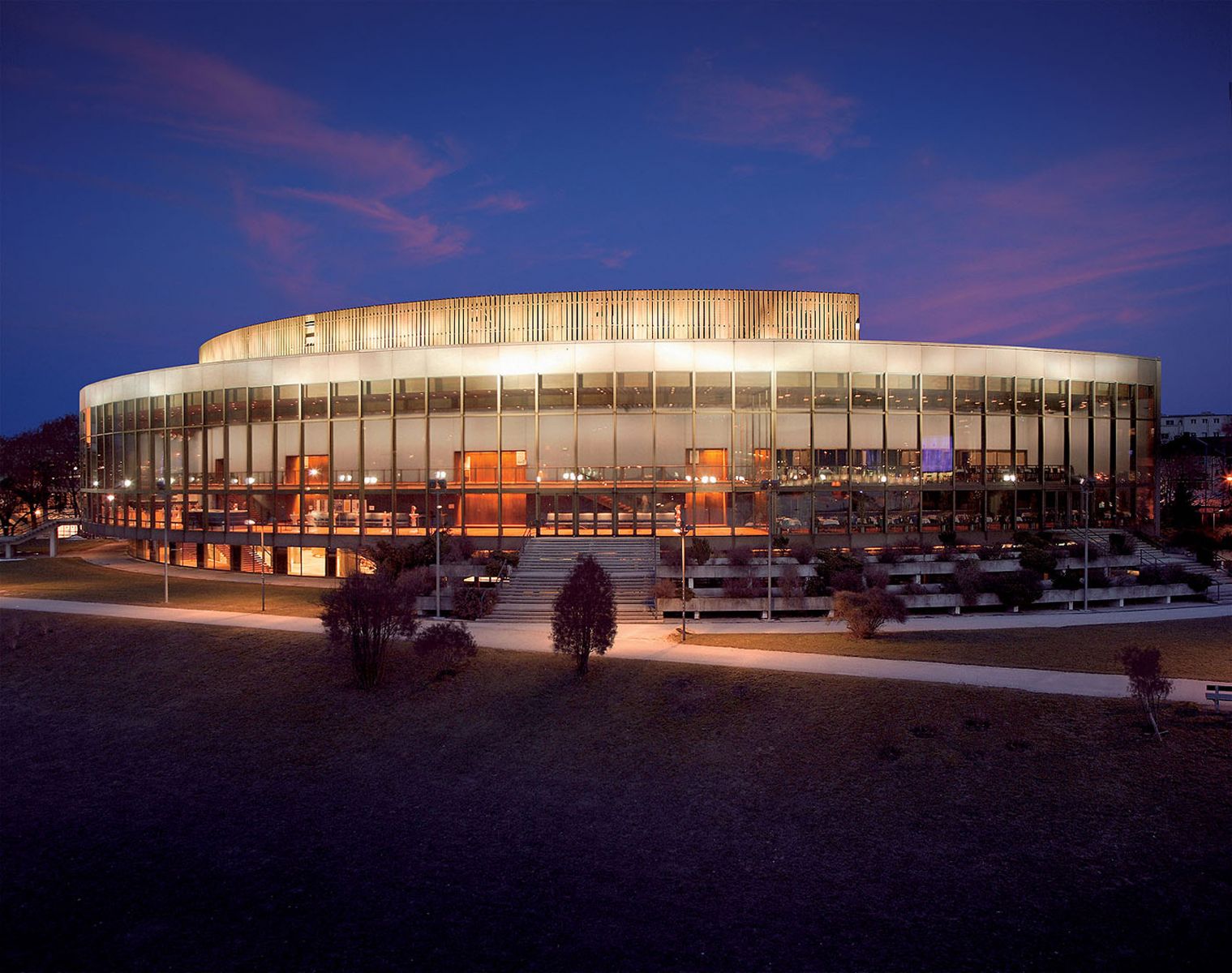
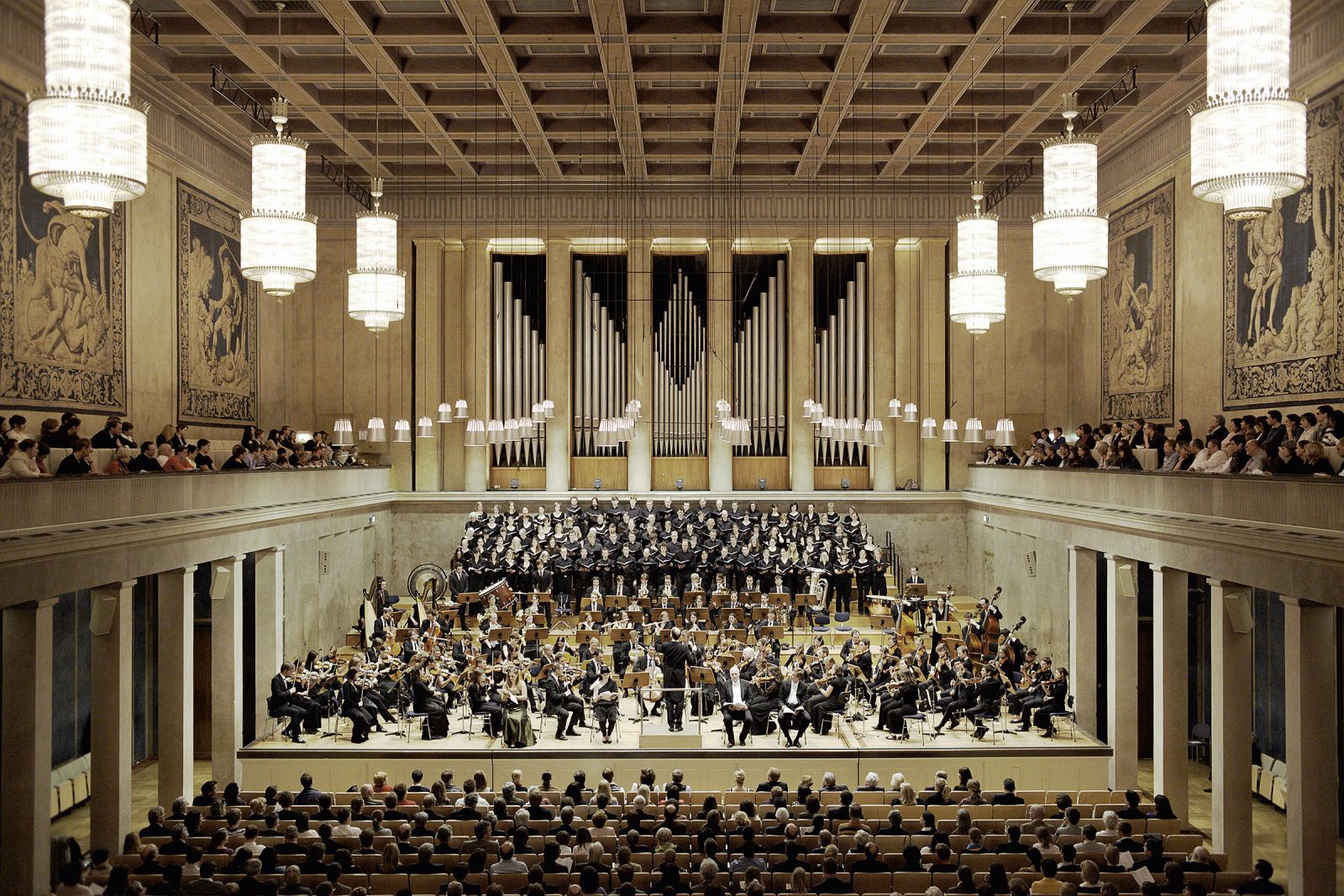

Brucknerhaus (Linz), Herkulessaal (Munich) and Festspielhaus (Bregenz).
International presence of the Orchestra
The Basque National Orchestra is an institution which never fails to fulfil its vocation as ambassador of the Basque culture. That’s why, over its 36 years, it has taken to international stages in different ways and with a variety of objectives.
It has performed in several Festivals and Seasons, such as the Biennale di Venezia and the Opéra Royal Château de Versailles (which it regularly attends with the Malandain Ballet Biarritz, an experience it will repeat in March 2019 with the premiere of “Marie Antoinette”).
Also in the orchestra exchange format, such as its exchanges with the Düsseldorf and Milan’s Giuseppe Verdi orchestras or the classic exchange with the ONBA from Bordeaux.
But its best known format is that of its concert tours, of which this one represents international tour number 18. Since 1984, the Orchestra has toured Argentina, Chile, England and Italy. But above all it has given numerous performances in different Central European cities in Germany (Frankfurt, Stuttgart, Passau, Bayreuth, Augsburg, Hamburg, Bremen, Düsseldorf and Munich), Austria (Vienna, Salzburg and Linz) and Switzerland (Lucerne, Gstaad and Zurich). It will now repeat its performance in Munich and Linz and will appear for the first time in Bregenz.
We should highlight, as a new example of relations between the Basque Country, Bavaria and the Austrian region of Vorarlberg, that our visit to Bregenz will be preceded by a collective exhibition “Bilbao – Bregenz” at the Kunsthaus Bregenz, an exhibition commemorating the work of the 40 artists who have participated in exchanges between the Kunsthaus Bregenz and BilbaoArte over the last 10 years (2006-2016).
Tour programme
4th December 2018: Brucknerhaus, Linz (Austria)
AITA DONOSTIA: Meditación
W.A. MOZART: Selection of soprano arias and church sonatas:
- Church sonata no. 14, k.278
- Ergo interest… Quaere superna, Recit and Aria in G major, K.143 (73a)
- Vesperae solennes de confessore, K.339. “Lauate Dominum” in F major,
- Church sonata no. 16, in C major, K.329 (317a)
- Coronation Mass, K.317. “Agnus Dei” in F major
G. MAHLER: Symphony no. 4
Robert Treviño, conductor
Mojca Erdmann, soprano
6th December 2018: Herkulessaal, Munich (Germany)
P. SOROZABAL: Siete Lieder (selection)
E. ELGAR: Enigma Variations, Op.36
G. MAHLER: Symphony no. 4
Robert Treviño, conductor
Mojca Erdmann, soprano
8th December 2018: Festspielhaus, Bregenz (Austria)
P. SOROZABAL: Siete Lieder (selection)
S. PROKOFIEV: Concerto for violin and orchestra no. 2
G. MAHLER: Symphony no. 4
Robert Treviño, conductor
Mojca Erdmann, soprano
Vadim Gluzman, violin
Robert Treviño extends his time at the forefront of the Basque National Orchestra to five seasons
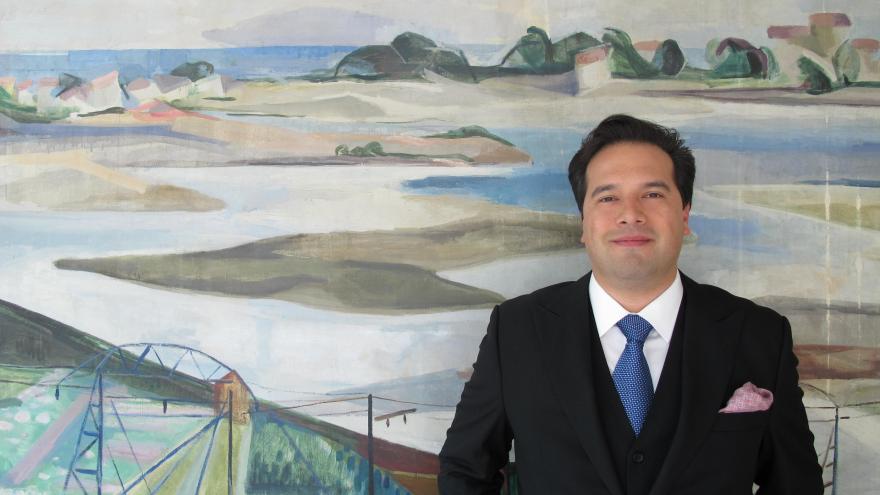
In the coming days, and having completed the last programme of concerts in the 2017/2018 Season with the direction of Verdi’s Requiem, Robert Treviño will have finished the first of the three seasons initially agreed to as Chief Conductor of the Basque National Orchestra.
After this time, and having observed the rise in quality and artistic results obtained as the Orchestra conductor, Robert Treviño’s contract has been extended for another two years. His presence as artistic head of the Orchestra will therefore encompass a musical period of five seasons, until 2021/2022.
As the leading artistic figure with the Basque National Orchestra, Robert Treviño has demonstrated his commitment to the Orchestra, to culture and to the country. This 2017/2018 Season has seen him front six concert programmes (26 concerts). But he has similarly contributed to education with our Music Room Concerts for Schoolchildren, also becoming involved in Musikene and the Master’s Degree in Orchestral Studies, with exclusive dedication to his students to help them improve and complete their training.
In his interest and commitment to Basque music he is also the first chief conductor of the Orchestra to participate in Musikaste, tackling for its closing event a programme completely focussed on Basque composers.
As well as his commitment and presence in the Basque Country, Robert Treviño has set new landmarks in the international sphere, having obtained in recent months great praise at the head of orchestras like the London Symphony, the London Philharmonic and the Zurich Tonhalle. Now he takes yet another step forward, preparing the tour of his orchestra, with which he is enormously proud to perform in Central European concert halls of enormous musical tradition and exacting audiences: the Herkulessaal in Munich, Brucknerhaus in Linz and the Festspielhaus in Bregenz.
More information
Robert Treviño official webHosokawa and Saint-Saëns: two important recordings by the Basque National Orchestra on the world market
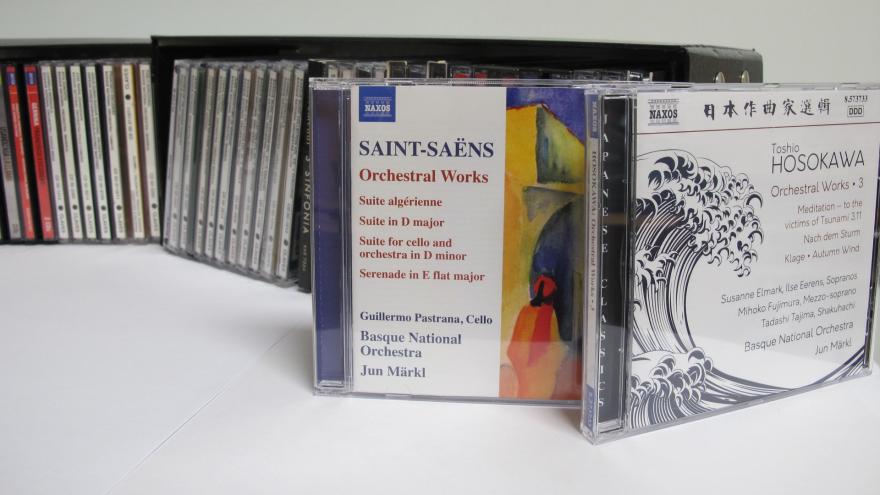
The Basque National Orchestra adds to its record library two new recordings of enormous relevance on the international market: Hosokawa, with the unpublished recording of works by one of the most important contemporary composers, and Saint-Saëns, with a compendium of orchestra works completing the composer’s catalogue on the Naxos label. The two albums have as their music director the former chief conductor Jun Märkl and have been recorded by the said label, a prestigious record company which distributes all over the world.
Together with the commitment to address and conserve Basque music production – which has its most outstanding example in the Basque Music Collection (15 volumes-CLAVES Label), the Basque National Orchestra has extended its recordings policy to include the international repertoire. It now brings this outstanding example which will enable the Orchestra to present itself to the most international market in singular fashion and thanks to distribution by NAXOS.
TOSHIO HOSOKAWA and the unpublished recording of orchestra works
This recording presents the Orchestra’s most contemporary aspect, combining different elements which make it enormously important and place it among the most distinguished recordings on NAXOS Records. On the one hand, it is the first world recording of all of the works compiled and includes performances by the soloists who first released it: Susanne Elmark and Ilse Eerens (sopranos), Mihoko Fujimura (mezzo soprano) and Tadashi Tajima (shakuhachi/Japanese flute). On the other hand, the recording is presented thanks to the coming together of a series of factors which made it possible: the Japanese roots of Jun Märkl, his friendship with Toshio Hosokawa and coincidence of the EU JAPAN FEST organisation’s sponsorship of the European Capital of Culture and therefore of San Sebastian 2016. All of this meant that the self-same Hosokawa, one of today’s most distinguished composers, was present at the recording in the Orchestra’s Miramon headquarters where he demonstrated his emotion at the carrying out of this project, which includes for example in ‘Meditation’ a tribute to the victims of the Japan tsunami of 2011. The album will be released onto the market in the coming days. It is already on sale in the United States and Canada via naxos.com.
See the record details and listen to the promotional audio here
The following video shows part of the process of recording ‘Orchestal Works 3’ by Toshio Hosokawa and the Basque National Orchestra:
Toshio Hosokawa / Basque National Orchestra: Orchestral Works 3 (EN) from EUSKADIKO ORKESTRA on Vimeo.
In the following images we can see Toshio Hosokawa working at the Miramon Orchestra Headquarters (click on the images to enlarge and download them):


SAINT-SAËNS and the French composer’s complete collection for the NAXOS label
With the recording of the orchestra works included in this copy the NAXOS label has covered the totality of the works by the French composer, Camille Saint-Saëns. This is a compendium of four works written by the composer at different times of his creative period. The cellist from Granada, Guillermo Pastrana, also joins the recording, lending voice to the ‘Suite Op16bis’ for cello and orchestra. Jun Märkl, a great specialist in the French repertoire, leads the conducting of this new and magnificent album. The CD is now on the market and available for purchase.
See the record details and listen to the promotional audio here